
The retail industry is built on moments—every customer interaction, every product recommendation, and every service experience shapes brand perception. In such a dynamic environment, the performance of store teams directly determines business success. Yet, training retail employees at scale—across locations, roles, and constantly evolving product lines—remains one of the biggest challenges for organizations.
Traditional corporate training approaches delivered through a basic learning management system often rely on static training content and one-time learning modules. These methods increase training time but fail to deliver engaging experiences that build employee confidence or improve real-world performance. As a result, organizations struggle with low user engagement, higher employee turnover rates, and inconsistent customer experience.
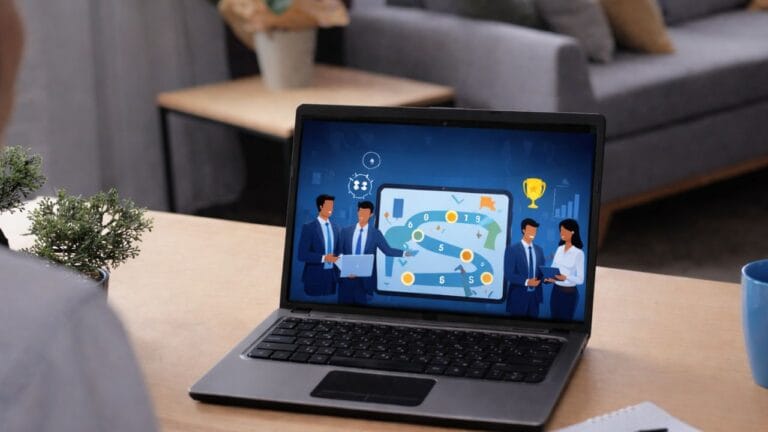
This is where gamified training is transforming the modern training platform. By integrating game design elements, progress bars, interactive tasks, and real-world simulations, retail chains are turning workplace learning into an engaging experience that aligns with real workplace requirements and drives measurable business outcomes.
Why Gamification is Redefining Retail Training
Retail environments demand agility, speed, and consistency. Store managers and frontline teams must continuously update their knowledge of products, sales techniques, and operational processes such as POS systems and inventory management.
Gamification addresses these challenges by applying principle, where learners remain fully engaged in an activity when challenges and skills are balanced.
- Improved user engagement through immersive learning experiences
Gamified systems create an engaging training feel by combining challenges and rewards, ensuring learners stay focused and motivated. - Faster learning and application of knowledge
Interactive learning modules enable employees to learn and apply knowledge immediately in real-world retail scenarios. - Reduction in employee turnover and training fatigue
Engaging training methodologies reduce repetitive learning cycles, improving retention and lowering turnover rates.
This shift makes learning more aligned with modern digital transformation goals in retail.
The Core Idea: Learning That Feels Like Playing
Gamification transforms workplace training into an experience where employees are not just learning but actively participating.
Instead of passive consumption, employees interact with simulation games, mobile learning and virtual environments, making training more intuitive and effective.
- Game-based learning modules with real-world relevance
Employees engage in simulation-based learning that reflects real retail challenges such as handling customers or managing service bays. - Progress-driven motivation using progress maps and bars
Visual indicators like progress bars and maps provide a clear sense of achievement, encouraging continuous participation. - Self-paced learning combined with distributed practice
Micro learning and self-paced modules allow employees to learn at their own speed while reinforcing knowledge over time.
This approach ensures that learning is both engaging and aligned with real-world retail operations.
Key Gamification Features Driving Retail Training Success
To deliver measurable results, gamification must be feature-driven and strategically implemented within the learning ecosystem.
Points, Rewards, and Incentive Systems
These systems reward employees for completing training modules and achieving milestones, reinforcing positive behavior and improving employee confidence.
Leaderboards and Competitive Ranking
Leaderboards create healthy competition among store teams, driving performance while aligning learning outcomes with Key Performance Indicators.
Levels, Progression, and Progress Maps
Structured progression systems guide learners through content pathways, ensuring continuous skill development while providing a clear sense of achievement.
Scenario-Based Challenges and Real-World Simulations
Simulation-based training replicates real-life retail situations, such as managing customer data or handling inventory shrinkage, enabling risk-free practice.
Gamified Assessments and Interactive Quizzes
Interactive quizzes reinforce knowledge and provide instant feedback, helping employees identify and address learning gaps.
Badges, Recognition, and Integrity-Based Learning
Recognition systems reward ethical behavior, improving compliance with security protocols and reducing risks like employee theft.
Micro Learning and Mobile Learning
Short, focused modules delivered via mobile apps enable continuous learning without disrupting daily store operations.
These features collectively create a high-impact gamification platform that integrates seamlessly into the corporate ecosystem.
Enhancing Product Knowledge Through Gamified Learning
Retail employees must stay updated with evolving product lines and customer preferences. Gamification simplifies this process by making product training interactive and engaging.
- Interactive product-based challenges
Employees participate in tasks that test product knowledge, improving retention and application in customer interactions. - Real-time feedback through performance analytics
Immediate insights help learners refine their understanding and improve sales techniques. - Integration with digital signage and content updates
Training content is continuously refreshed, ensuring employees stay aligned with the latest offerings.
This approach ensures that product knowledge directly enhances customer loyalty and sales performance.
Driving Sales Performance with Gamification
Gamification plays a critical role in improving retail sales by aligning learning with performance outcomes.
- Sales simulations and interactive training scenarios
Employees practice real-world sales situations, improving their ability to convert leads and handle objections effectively. - Performance-based incentives linked to KPIs
Rewards tied to performance metrics motivate employees to achieve higher targets and improve productivity. - Skill-based progression for advanced job skills
Employees unlock advanced training as they improve, ensuring continuous development aligned with business goals.
This creates a direct connection between training and revenue growth.
Improving Customer Experience Through Behavior-Based Training
Customer experience is influenced by how employees interact with customers at every touchpoint. Gamification enhances these interactions by focusing on behavior.
- Customer interaction simulations in virtual environments
Employees practice real-life scenarios, improving communication and problem-solving skills. - Safety awareness and compliance training
Gamified modules reinforce adherence to safety protocols, reducing incidents and ensuring regulatory compliance. - Real-time feedback for continuous improvement
Immediate insights help employees refine their approach and deliver consistent service.
This ensures that training directly impacts customer satisfaction and brand perception.
Enabling Continuous Learning in Retail Environments
Retail teams operate in fast-paced environments where time is limited. Gamification ensures that learning remains continuous and accessible.
- Daily challenges and interactive tasks
Short learning activities keep employees engaged without disrupting operations. - Mobile-first learning platforms
Employees can access training anytime, supporting flexible learning. - Continuous updates aligned with workplace requirements
Training evolves with changing retail trends, ensuring relevance.
This creates a culture of ongoing learning and development.
Leveraging Data for Smarter Training Decisions
Gamified platforms generate valuable insights that help organizations optimize training strategies.
- Performance analytics and engagement metrics
Data-driven insights help track learning progress and identify areas for improvement. - Identification of performance gaps and risks
Analytics highlight issues such as inventory shrinkage or compliance failures. - Alignment with business outcomes and KPIs
Training effectiveness is measured against real-world performance metrics.
This ensures that training is both strategic and measurable.
Scaling Training Across Multi-Store Retail Networks
Retail chains often operate across multiple locations, making consistency a challenge. Gamification enables scalable and standardized training.
- Centralized training platforms for distributed teams
All employees receive consistent training regardless of location. - Easy rollout of updates and new programs
Training content can be quickly updated and deployed across stores. - Integration with broader corporate learning systems
Learning aligns with HR and operational systems for better efficiency.
This ensures consistent performance across the organization.
Final Thoughts
Retail chains are increasingly adopting gamified training to address the challenges of modern workforce development. By combining interactive learning, real-world simulations, and data-driven insights, gamification transforms training into an engaging and performance-driven experience.
In an industry where every interaction matters, the ability to train employees effectively at scale is critical. Gamification ensures that store teams are not just trained—but equipped to deliver exceptional customer experiences consistently.