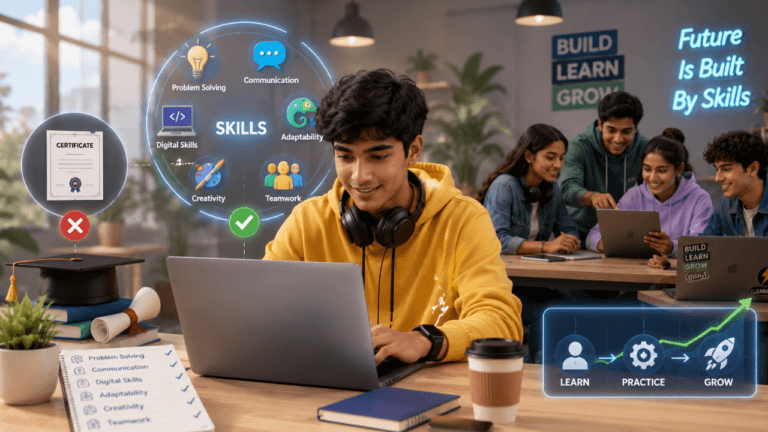

Workplace learning has traditionally relied on structured courses, scheduled sessions, certifications, and predefined learning paths. But the way people work is changing faster than these models can always accommodate. New technologies, evolving roles, and growing skill gaps require organizations to make learning more accessible and relevant. AI-based employee training offers one way to address this shift by using artificial intelligence to personalize learning, automate repetitive processes, analyze performance data, and provide support when it is needed. The bigger opportunity, however, is not simply adding AI tools to existing learning programs. It is creating a more responsive learning environment around the individual.
What Is AI-Based Employee Training?
AI-based employee training uses technologies such as machine learning, generative AI, natural language processing, and predictive analytics to improve different parts of the learning journey. AI capabilities can help identify skill gaps, recommend content, create learning paths, provide real-time feedback, and support knowledge discovery.
For example, someone preparing for a new role may receive recommendations based on their existing skills and performance rather than following the exact same curriculum as everyone else. This creates a shift from standardized learning to personalized learning.
How AI Is Changing Workplace Learning
1. Personalization Based on Skills and Needs
Traditional programs often use role-based courses as the starting point. AI can make personalisation and recommendations more dynamic. Algorithms can analyze performance data, completed courses, demonstrated skills, and learning behavior to suggest relevant resources.
This can support:
- Personalized learning paths: Individuals receive content aligned with their current capabilities and development goals.
- Adaptive learning: The learning experience can change based on performance and progress.
- Targeted reskilling: Learning recommendations can focus on skills required for emerging roles.
2. Learning in the Flow of Work
People do not always need a full course when they encounter a problem. Sometimes they need a quick answer, example, procedure, or explanation. AI knowledge assistants can support learning in the flow of work by helping people access relevant information using natural-language questions.
This can be particularly useful when employees need to understand an SOP, clarify a process, or find information while completing a task. Learning therefore becomes less dependent on scheduled sessions and more connected to everyday work.
3. Faster Content Creation
Generative AI can accelerate content creation by helping L&D teams develop outlines, explanations, assessments, scenarios, scripts, and other learning assets.
AI authoring tools can also support the development of training videos, microlearning, simulations, and interactive content. However, speed should not replace quality control. Subject matter experts still need to review content for accuracy, organizational context, and relevance.
4. Real-Time Feedback and Assessment
AI can make assessment more continuous. Instead of relying only on completion and end-of-course tests, AI-powered LXP can use performance metrics, assessments, simulations, and interaction data to identify areas that require reinforcement.
Real-time feedback can help learners understand where they are making mistakes and what they should practice next. For L&D teams, these signals can also contribute to broader skill gap analysis.
5. Smarter Workforce Development
AI can connect learning data with broader talent development initiatives. When skills, performance, role requirements, and learning activity are analyzed together, organizations can identify areas for reskilling and development.
This can support decisions around internal mobility, leadership development, capability building, and future workforce requirements. The focus shifts from simply measuring course completion toward understanding whether organizational capabilities are developing.
Where AI Can Add the Most Value
AI-based learning can be particularly useful in environments where information changes frequently or large workforces require continuous support.
Potential applications include:
Onboarding: New hires can receive personalized learning paths based on their roles and responsibilities.
Product and process knowledge: AI knowledge search can help people quickly find information instead of searching through large content libraries.
Leadership development: AI can support reflection, scenario-based practice, and personalized development recommendations.
Technical upskilling: Adaptive learning can help individuals build digital, data, AI, or other role-specific capabilities progressively.
Frontline learning: Microlearning and contextual assistance can make knowledge easier to access for workers who are not continuously at a desk.
AI Literacy Is Becoming a Workforce Capability
Organizations adopting AI also need to prepare people to use it responsibly. AI literacy goes beyond knowing how to interact with a chatbot. People may need to understand prompt engineering, data privacy, bias, AI limitations, verification, and responsible decision-making.
An effective AI skills curriculum can therefore include:
- AI fundamentals: Builds an understanding of how AI systems work and where they can be applied.
- Practical AI skills: Helps people use AI capabilities within their specific roles.
- Responsible AI: Covers bias, privacy, security, transparency, and appropriate human oversight.
- AI governance: Establishes clear expectations around acceptable use and organizational policies.
Challenges Organizations Should Consider
AI adoption also introduces new responsibilities.
Data privacy: Performance and learning data should be collected and used responsibly, with appropriate access controls.
Bias: Algorithms can reproduce biases present in the data used to develop or operate them, making regular evaluation important.
Content accuracy: AI-generated information requires human review, particularly when learning involves operational, regulatory, or safety-sensitive topics.
Governance: Organizations need clear policies defining how AI systems can be used, what information can be entered, and when human decision-making is required.
What Does the Future Look Like?
The next phase of workplace learning is likely to be less about completing a fixed catalogue of courses and more about continuously developing capabilities. AI can connect skill gap analysis, personalized learning, real-time analytics, content creation, assessments, and learning support into a more connected ecosystem.
The result could be a learning experience that responds to what people know, what they need to accomplish, and which capabilities the organization needs next. For L&D teams, this creates an opportunity to move beyond content administration and focus more closely on capability development and business value.
Final Thoughts
AI-based learning platforms are ultimately about making learning more contextual, personalized, and responsive. AI can help organizations identify skill gaps, recommend relevant learning, accelerate content creation, provide real-time feedback, and support people during everyday work. But technology alone does not create better learning. Strong content, human expertise, responsible AI practices, and clear business objectives remain essential. The organizations that gain meaningful value from AI will be those that use it to solve specific learning and workforce challenges—not simply those that adopt the most AI capabilities.
FAQs
1. What is AI-based employee training?
It uses artificial intelligence to personalize learning, content recommendations, analyze performance, automate processes, and provide contextual support throughout the learning journey.
2. How does AI personalize workplace learning?
AI can analyze skills, performance, learning activity, and role requirements to recommend relevant content and create more individualized learning paths.
3. Can AI help identify skill gaps?
Yes. AI can analyze performance data, assessments, skills, and role requirements to identify capability gaps and inform reskilling or development initiatives.
4. Why is AI literacy important for organizations?
AI literacy helps people understand how to use AI effectively while recognizing issues such as bias, privacy, limitations, verification, and responsible decision-making.
5. Will AI replace traditional workplace learning?
AI is more likely to change how learning is delivered and supported. Human expertise remains important for instructional design, subject matter validation, governance, and strategic L&D decisions.