
Table of contents
Overview
Modern organizations face a significant hurdle in training: high-caliber talent often fails to complete courses because the delivery lacks engagement. As many talent acquisition managers have noted, the problem rarely lies within the content itself, but rather in how it is presented. By adopting a game-based learning approach, companies can move away from static presentations and toward interactive experiences. This overview explores how gamification leverages psychological drivers and educational theories to boost completion rates and ensure learners effectively master new skills.
The Engagement Gap in Modern Training
Many managers and teachers wonder how to make their trainee’s learning experience exciting. They are concerned about the delivery potential of their employees. I recently talked to a talent acquisition manager. She said, “the newbies that are selected are of great calibre but only 10 % of them are able to complete the course.” Interestingly the concerns were not about the content but the way it is presented to the trainee, which was far from being game-based.
The Power of Gamification
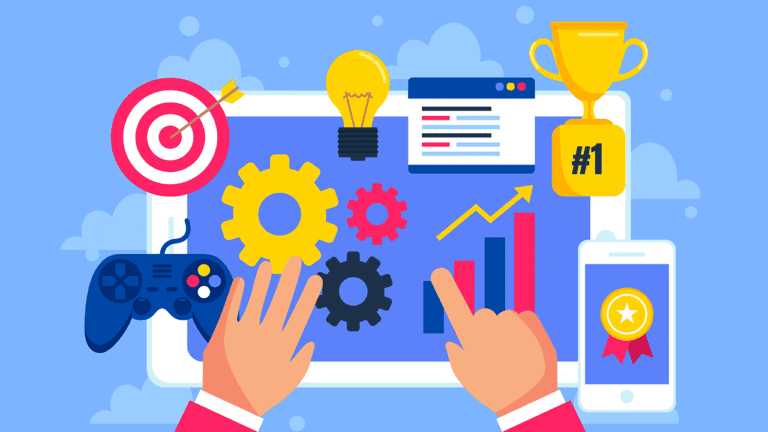
A user through game-based learning or gamification approach could carry out the learning process effectively. When we are actively engaged with a game, our mind experiences the pleasure of understanding a new system. Similarly, we try to achieve a target as we do in a game. Once a target is set and reached, a gamer craves to complete more levels and achievements.
Now when learning is integrated into this, one can easily imagine that quality of learning is definitely improved. E-learning companies, verified through SCORM are creating game-based mobile apps. They are used to help learners get hold of the course content when they are both online and offline.
Classification: Core Game Theories
There are three main game theories (based on gamified platforms):
- Activity Theory: Learners are allowed to participate and experiment in non-threatening scenarios.
- Experiential Learning: Games support learning by doing.
- Situated Learning: Information is provided in the relevant context or setting within the game. Learning takes place alongside social interaction and collaboration.
Custom Models and Interactive Features
Although these theories are there, custom models are more popular. These personalized modules are created while designing platforms according to the interests of the targeted-users. Game-based learning platforms are being developed in such a manner so as to digitize content according to different target audience.
A learner’s benefits are supported by features like:
- Characters & Timelines
- Customizable Player
- Programming Logic: Triggers, States, and Variables.
- Interactivity Tools: Markers, Lightboxes, Buttons, and Freeforms.
Game-based learning supports all the SCORM, AICC, and Tin Can-compliant Learning Management Systems (LMS).
FAQ
Q:Why is gamification more effective than traditional course delivery?
A:Gamification triggers the brain’s reward system. When a learner reaches a target or unlocks an achievement, they experience a sense of progress that encourages them to continue through higher levels of the course, significantly improving completion rates.
Q:Can game-based learning be accessed without an internet connection?
A:Yes. Many e-learning companies develop game-based mobile apps that allow learners to engage with the course content both online and offline, ensuring flexibility for professionals on the move.
Q:Will gamified content work with my existing LMS?
A:Most game-based learning platforms are designed to be highly compatible. They support standard protocols like SCORM, AICC, and Tin Can (xAPI), allowing them to integrate seamlessly with your current Learning Management System.
Final Thoughts
The transition from traditional e-learning to gamified experiences is the key to unlocking the full potential of high-caliber employees. By utilizing characters, interactive triggers, and situated learning theories, organizations can turn a chore into a challenge that employees actually want to complete. Ultimately, gamification doesn’t just make learning “fun” it makes it stick, ensuring your investment in talent leads to measurable performance.
Feel free to share your thoughts.