
Table of contents
- Overview
- The Rapidly Evolving Bottlenecks in IT and Software Training
- Deploying Gamification Strategies in Tech Employee Training
- Gamification in Action: Real-World IT and Software Examples
- Key Business Benefits of Gamified IT Training Programs
- FAQ
- Q:Does technical gamification require buying expensive third-party sandbox platform accounts for everyone?
- Q:Can development leaderboards cause unhealthy code competition or discourage junior engineers?
- Q:How do engineering compliance offices track technical training data from interactive coding games?
- Final Thoughts
Overview
Modern technology organizations and enterprise engineering teams no longer rely on dense documentation manuals. Long, theoretical lecture slideshows fail to train today’s developers effectively. Software frameworks and deployment practices evolve rapidly. At the same time, live production systems require absolute operational stability.
Because of these fast-paced pressures, traditional corporate upskilling models face low engagement and poor knowledge retention. Technical professionals simply do not absorb complex architecture patterns or security protocols through passive reading. Consequently, forward-thinking tech enterprises are adopting modern gamification strategies for it software employee training to bridge this capability gap. By integrating game-design mechanics into non-gaming corporate environments, businesses transform dry code syntax and compliance guidelines into active, high-retention learning experiences.
When implemented with clear data tracking, these interactive methodologies change everything. They turn an uninspiring box-checking exercise into an engaging, self-directed skill loop. This guide reviews operational examples of how executing targeted gamification strategies for it software employee training can safeguard production pipelines. Ultimately, it showcases how top technology firms maximize engineering output while building deep employee capabilities at scale.
The Rapidly Evolving Bottlenecks in IT and Software Training
Traditional software education methodologies encounter severe limitations when deployed across fast-paced engineering environments. Without dynamic feedback loops, online compliance and technical onboarding courses face heavy employee friction.
Common technology training hurdles include:
- The Engagement Void: Static architecture lectures and dry code-style guides fail to capture developer focus during busy sprint cycles.
- Lack of Intrinsic Motivation: Linear training tracks offer zero personal milestones. This makes learning new programming languages and security refreshers feel tedious.
- Invisible Progress Tracking: Standard learning systems hide skill development inside complex corporate menus. This leaves busy engineers unaware of their exact framework certification standing.
- Dangerous Knowledge Decay: Without immediate operational testing, system administrators quickly lose newly introduced cloud optimization steps. This decay risks catastrophic deployment failures or severe cloud infrastructure cost overruns.
Deploying Gamification Strategies in Tech Employee Training
Gamification systematically resolves these operational bottlenecks by introducing game mechanics directly into the daily engineering routine. Instead of waiting for high-stakes annual assessments, employees interact with a continuous stream of low-stakes micro-feedback loops.

By utilizing elements like points, progress trackers, time-based troubleshooting challenges, and interactive code sandboxes, software firms align corporate learning with natural human behaviors. Consequently, this architecture changes digital training from a rigid mandate into an engaging, self-paced pull model. Employees can easily digest these specialized modules without disrupting active sprint schedules.
Gamification in Action: Real-World IT and Software Examples
Immersive Code Quests and Competitive Hackathons
Modern Learning Management Systems (LMS) in the technology sector utilize game mechanics by transforming standard technical documentation into interactive code quests. Instead of scrolling through flat programming guides, a developer navigates a virtual troubleshooting map. The system challenges them to spot hidden memory leaks, optimize slow database queries, and patch security vulnerabilities within an isolated testing branch.
The user completes these interactive tasks to earn experience points (XP) and climb engineering leaderboards. This direct gamified approach keeps technical training fresh and highly engaging. It turns compliance and code mastery into an active, competitive mission that builds sharp debugging reflexes before engineers push code to the live production repository.
Real-Time Lab Simulations and Live Sandboxes
Mastering new cloud infrastructure tools requires engineers to practice complex configuration patterns under pressure. To meet this need without risking real-world downtime, top IT firms integrate gamified modules with live sandbox labs.
An engineer opens a secure, isolated cloud profile where the software simulates live system tasks. The lab engine guides them through a step-by-step microservices setup, awarding efficiency points and uptime bonuses for configuring load balancers flawlessly. This safe environment builds deep technical competence, completely insulating the organization from early operational deployment accidents.
Achievement Badges for New Tech Stack Progression
Modern software departments manage diverse arrays of technical tools, database schemas, and front-end frameworks. To ensure developers possess true framework competence before contributing to client applications, L&D teams organize content into progressive stack quizzes.
As an engineer proves mastery over a specific runtime toolset, the system automatically awards a verified digital milestone badge to their profile. These badges serve as real-time proof of full-stack readiness. This visual system simplifies team balancing for engineering managers. It also satisfies the human desire for incremental career achievement.
Problem-Solving Competitions and Gamified Bug Bounties
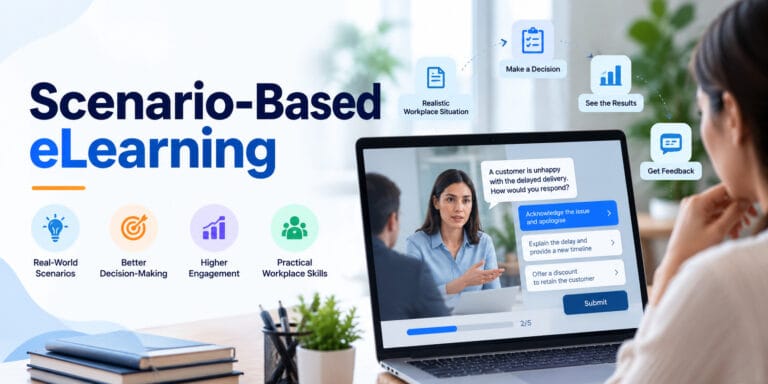
Product stability relies heavily on proactive unit testing and excellent automated regression workflows. To build these vital habits, software businesses deploy interactive, SCORM-compliant problem-solving simulations built on advanced authoring suites. Developers face realistic, high-stakes system failures on screen, such as a major server outage or a compromised security firewall.
The course forces immediate decision-making. Each distinct user path alters the simulation outcome in real time. This delivers immediate visual and data-driven feedback on the downstream consequences of every architectural choice.
Key Business Benefits of Gamified IT Training Programs
When technology organizations strategically deploy gamification across their training ecosystems, they unlock multiple data-driven benefits:
- Encourages Continuous Learning: Interactive milestone tracking and dynamic badge awards motivate developers to voluntarily update their skills, keeping the company ahead of technical obsolescence.
- Promotes Cross-Functional Innovation: Immersive code quests and design challenges prompt engineers to experiment with new algorithms and design patterns in a safe environment.
- Improves Core Problem-Solving Speed: Real-time sandbox labs and live troubleshooting simulations train technicians to diagnose system issues quickly under pressure, drastically reducing real-world system downtime.
- Ensures Faster Employee Onboarding: Gamified progress trees compress complex stack ramp-up timelines. This helps new hires reach full coding productivity much faster, maximizing engineering velocity.
FAQ
Q:Does technical gamification require buying expensive third-party sandbox platform accounts for everyone?
A:No. Effective IT gamification can apply basic game design mechanics—such as interactive LMS troubleshooting tasks, tech stack milestone badges, and branching mobile logic quizzes to standard training documentation.
Q:Can development leaderboards cause unhealthy code competition or discourage junior engineers?
A:Yes, if designed poorly. To prevent internal friction, modern tech platforms focus leaderboards on team-based sprint milestones or personal learning consistency streaks rather than publicizing individual low scores.
Q:How do engineering compliance offices track technical training data from interactive coding games?
A:These modules use global technical standards like SCORM or xAPI. This integration allows the games to pass specific performance metrics such as syntax choices, diagnostic test coverage scores, and attempts directly to your central LMS dashboard.
Final Thoughts
In conclusion, successfully executing gamification within IT and software employee training programs represents a fundamental shift in technical content strategy. By moving past passive, lecturing instruction models, software networks transform mandatory security compliance and stack onboarding into an active process. This new approach directly respects human behavioral psychology.
Whether utilizing interactive LMS code quests, real-time lab simulations, or branching process simulations, interactive learning architectures consistently deliver superior engineering results. Ultimately, prioritizing gamification transforms an IT brand’s internal training layer. It changes an administrative cost center into a powerful engine for continuous skill development, operational stability, and bottom-line engineering success.