

Quick Summary
LMS gamification makes corporate training more interactive by incorporating points, badges, levels, challenges, leaderboards, rewards, and progress tracking to improve learner engagement, motivation, knowledge retention, and participation.
Stratbeans supports gamified corporate training through its LMS, combining gamification with microlearning, assessments, analytics, AI-powered learning, mobile learning, and WhatsApp-based learning to help organizations deliver engaging and measurable employee training programs.
Employee training can become difficult to sustain when learning consists mainly of lengthy modules, presentations, and assessments. This is where gamification can add more interaction to your existing training programs.
An LMS with gamification introduces selected game elements into learning without turning corporate training into a conventional video game. Points, badges, levels, challenges, progress indicators, rewards, and leaderboards can encourage employees to participate and complete learning activities.
Recent research supports its potential in workplace learning. A 2025 systematic literature review published in the Journal of Workplace Learning examined 49 empirical studies and found that gamification can support employee engagement, motivation, knowledge retention, and performance. The review also noted that results depend on factors such as design quality, learner characteristics, and organisational context.
What Is LMS Gamification?
LMS gamification means adding selected game-design elements to an LMS to make learning more interactive and motivating. You do not need to build an entire game. Instead, your existing courses can include features such as –
- Points for completing activities.
- Badges for achieving milestones.
- Levels based on learning progress.
- Leaderboards for friendly competition.
- Challenges and missions.
- Progress bars.
- Rewards and recognition.
- Streaks for consistent learning.
- Instant feedback.
- Scenario-based activities.
For example, an employee completing a cybersecurity course could earn points after each module, receive a badge after passing the final assessment, and move to the next level after completing all required training.
The objective is to make participation more visible and give employees regular feedback about their progress.
How Does Gamification in LMS Actually Work?
An LMS with gamification connects learning activities with specific game mechanics. The process works in five stages:
- Define the learning objective: First, identify what employees should know or be able to do after completing the training.
- Select suitable game elements: Choose points, badges, challenges, levels, rewards, or other mechanics based on the learning objective.
- Connect actions with rewards: Employees can earn points for completing modules, passing assessments, participating in discussions, or completing practical activities.
- Provide immediate feedback: Employees can see their progress, scores, achievements, or areas that require improvement.
- Measure the outcome: Your L&D team can compare participation, completion, assessment results, retention, and other relevant metrics.
This structure helps ensure gamification stays connected to real learning outcomes.
Transform Employee Training with Stratbeans Gamification Solutions
Book a DemoBenefits of LMS Gamification for Corporate Training
When designed appropriately, gamification can support several areas of employee learning.
- Higher learner engagement: Points, challenges, progress indicators, and feedback can encourage employees to interact with training instead of passively moving through modules. A 2025 review of workplace research found that gamification has strong potential to improve employee engagement and motivation, although its effectiveness varies by implementation and context.
- Better motivation: Visible progress and recognition can give employees short-term goals within longer training programs.
- Improved knowledge retention: Gamified activities can give employees opportunities to recall information, practice decisions, and receive immediate feedback. Research on workplace gamification links these mechanisms to improved learning and knowledge retention, although outcomes depend on implementation quality.
- More active participation: Instead of simply reading or watching content, employees can answer questions, solve scenarios, complete challenges, and make decisions.
- Useful performance feedback: Scores, badges, progress indicators, and assessment results can give employees clearer information about their current performance.
- Social learning: Team challenges and collaborative activities can encourage employees to learn with colleagues while keeping competition optional and appropriate to the workplace.
Real LMS Gamification Examples
Here are practical ways you can use an LMS with gamification in corporate training.
- Onboarding challenge: Create a series of onboarding missions covering company policies, tools, departments, and workplace processes. Employees earn points as they complete each stage.
- Compliance training badges: Employees can earn digital badges after completing mandatory compliance modules and passing the associated assessments.
- Sales learning leaderboard: Sales teams can receive points for completing product training, sales simulations, and knowledge assessments. A leaderboard can display progress when friendly competition fits the team culture.
- Cybersecurity challenge: Employees can complete simulated phishing scenarios and security questions. Correct decisions earn points, while incorrect answers trigger explanations.
- Leadership learning levels: A leadership curriculum can be divided into levels covering communication, delegation, feedback, decision-making, and team management.
LMS Gamification Use Cases Across Corporate Training
Gamification can be applied to different types of employee learning.
- Employee onboarding: Use points, milestones, checklists, and badges to help new employees complete essential training during their first few weeks.
- Compliance training: Break lengthy compliance programs into smaller modules and use progress indicators, assessments, and completion badges.
- Product training: Create product knowledge challenges where employees answer questions, complete scenarios, and unlock advanced modules.
- Sales training: Use simulations, quizzes, role-play activities, and achievement systems to help sales employees practise customer interactions.
- Cybersecurity awareness: Scenario-based challenges can help employees practise identifying suspicious emails, unsafe links, password risks, and other security situations.
- Leadership development: Use learning paths, scenario-based decisions, reflection activities, and milestone badges across longer leadership programs.
- Technical training: Points and progress levels can help employees track their development across software, equipment, systems, and technical procedures.
Best Practices of LMS Gamification
An LMS with gamification works better when you design the mechanics around your learners rather than adding them simply because they are available.
- Start with learning objectives: Decide what behaviour, knowledge, or skill you want to develop before choosing the game mechanics.
- Keep rewards relevant: Badges and points should represent meaningful achievements. Too many rewards can reduce their perceived value.
- Provide immediate feedback: Employees should understand why an answer was correct or incorrect and what they should do next.
- Keep challenges achievable: Training should be challenging enough to encourage effort without making progress feel unrealistic.
- Give employees visible progress: Progress bars, levels, milestones, and completion indicators can help employees understand how far they have progressed.
- Make competition optional where appropriate: Leaderboards can motivate some employees but may discourage others. Consider team-based challenges, personal bests, or private progress tracking as alternatives.
- Review the data: Monitor completion rates, assessment scores, participation, time spent learning, and post-training performance to determine whether gamification is actually helping.
Common LMS Gamification Mistakes to Avoid
Gamification can lose its value when it becomes disconnected from learning. Avoid these common mistakes –
- Adding points without a clear purpose.
- Using leaderboards for every course.
- Rewarding course completion without checking understanding.
- Making activities excessively competitive.
- Overloading courses with animations and game mechanics.
- Using rewards that have little relevance to employees.
- Failing to provide useful feedback.
- Measuring participation without measuring learning outcomes.
How to Implement Gamification in an LMS
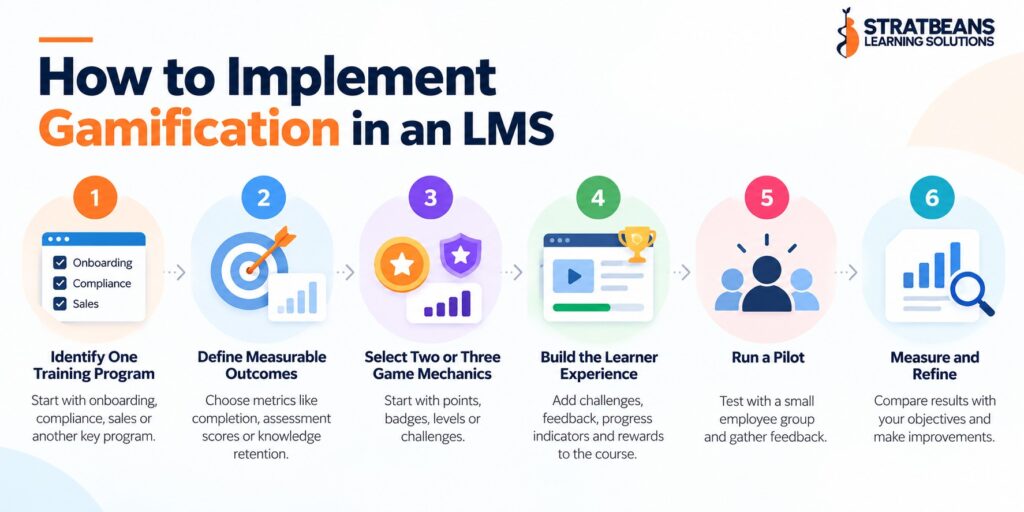
You can introduce gamification gradually rather than changing your entire learning system at once.
Step 1: Identify one training program: Start with onboarding, compliance, sales, or another clearly defined learning requirement.
Step 2: Define measurable outcomes: Choose metrics such as completion, assessment scores, knowledge retention, or application of skills.
Step 3: Select two or three game mechanics: For example, start with points and badges rather than using every available feature.
Step 4: Build the learner experience: Add challenges, feedback, progress indicators, and rewards to relevant parts of the course.
Step 5: Run a pilot: Test the program with a small employee group and gather feedback.
Step 6: Measure and refine: Compare the results with your original objectives and make changes before expanding the program.
How to Choose an LMS With Gamification Features
When evaluating an LMS with gamification, look beyond whether a vendor simply lists gamification as a feature. Check whether the platform offers:
- Points and badges.
- Levels and achievement milestones.
- Leaderboards.
- Challenges and quests.
- Progress tracking.
- Automated rewards.
- Customizable gamification rules.
- Team-based activities.
- Analytics.
- Mobile access.
- Integration with your HRMS.
- Assessment and certification capabilities.
You should also ask how easily your L&D team can configure these features without depending on developers for every change.
How Stratbeans Uses Gamification to Improve Your Corporate Training
Stratbeans combines LMS capabilities with gamification features designed to make corporate learning more interactive and measurable.
Its learning platform supports gamified training alongside microlearning, assessments, analytics, AI-powered learning, mobile learning, virtual training, and WhatsApp-based learning. This lets organisations choose gamification mechanics based on their specific training needs, rather than treating gamification as a separate activity.
For example, your organisation can use points and achievement systems within structured learning programs, while analytics can help L&D teams monitor participation and learning performance.
The platform can also support different employee groups, making gamification relevant for onboarding, compliance, product training, sales enablement, technical learning, and skill development.
Ready to Make Corporate Training More Engaging with Stratbeans?
Book a DemoConclusion
An LMS with gamification can make corporate training more interactive by giving employees clear goals, visible progress, regular feedback, and meaningful recognition.
If you are considering gamification for your corporate learning strategy, start with one measurable training objective, test a small program, review the results, and expand based on what works for your employees.
Stratbeans can help you design and manage corporate learning programs with gamification, analytics, AI-enabled learning, and other digital learning capabilities. Connect with the Stratbeans team to discuss how an LMS with gamification can fit your training requirements.
FAQs
What is LMS gamification?
LMS gamification uses game-design elements such as points, badges, levels, challenges, progress indicators, and rewards within an LMS to make employee learning more interactive and encourage participation.
How does gamification work in an LMS?
An LMS connects specific learning activities with game mechanics. Employees may earn points for completing courses, badges for achieving milestones, or rewards for successfully completing challenges and assessments.
What are the benefits of LMS gamification?
Potential benefits include higher engagement, increased motivation, active participation, better feedback, improved knowledge retention, and greater visibility into learner progress. Results depend on how well gamification is designed and aligned with the training objective.
What features should a gamified LMS have?
Useful features include points, badges, levels, leaderboards, challenges, progress tracking, rewards, assessments, analytics, mobile learning, and customizable gamification rules.
How can gamification improve employee training?
Gamification can give employees clear goals, frequent feedback, practice opportunities, and visible progress. These elements can make training more interactive and encourage employees to complete learning activities.
How do you measure LMS gamification success?
You can track metrics such as course completion, assessment scores, participation, time spent learning, knowledge retention, skill application, and post-training performance. Comparing these results against your original learning objectives gives you a clearer picture of effectiveness.