
Table of contents
Overview
For years, the Learning Management System (LMS) was the undisputed backbone of corporate training. It handled course assignments, compliance tracking, certification management, and reporting — and it did so reliably, at scale.
But as employee expectations evolved and digital learning environments matured, a new category of learning technology emerged: the Learning Experience Platform (LXP).
For L&D leaders and HR teams, understanding the distinction between these two platforms isn’t just a technical exercise — it’s a strategic decision that shapes how your entire learning ecosystem is designed and experienced.
Below are nine key differences that clearly define how LMS and LXP platforms function in modern corporate learning environments — and what each one means for your organization.
Quick Comparison: LMS vs LXP at a Glance
| Dimension | LMS | LXP |
|---|---|---|
| Primary Purpose | Training administration and compliance | Engagement, discovery, and personalized learning |
| Learning Approach | Administrator-driven, structured | Self-directed, learner-driven |
| Content Model | Courses and structured programs | Content ecosystems from multiple sources |
| Personalization | Predefined by administrators | AI-driven, adaptive in real time |
| User Experience | Functional, task-oriented | Intuitive, discovery-oriented |
| Social Learning | Limited — discussion boards only | Built-in — communities, sharing, collaboration |
| Analytics Focus | Completions and compliance metrics | Behavior, engagement, and skill insights |
| Skill Development | Structured programs and certifications | Continuous, flexible, self-paced |
| Ecosystem Role | Operational foundation | Engagement and experience layer |
Purpose of the Platform
The foundational difference between LMS and LXP lies in what each platform is fundamentally built to do.
They help organizations manage course assignments, compliance requirements, certification programs, and structured training modules — often integrating directly with HR and talent management systems. The administrator is in control, and the primary goal is ensuring employees complete required training.
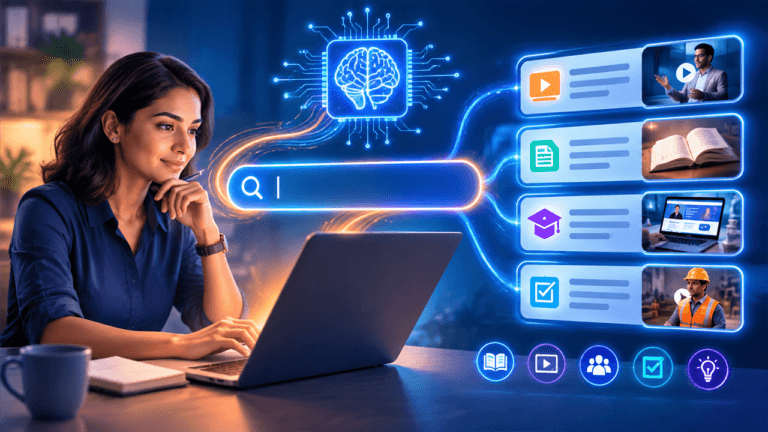
LXP platforms are designed around the employee learning experience. Rather than assigning courses, they help employees discover relevant knowledge through AI-powered content recommendations and curated learning paths — making the learner, not the administrator, the center of the experience.
Learning Approach
How learning is initiated, delivered, and managed shapes the entire employee experience of training.
LMS learning follows a structured, top-down model. Courses are assigned based on organizational training needs, compliance schedules, or predefined skill development plans. Employees follow prescribed paths through structured modules, virtual sessions, or classroom-based instruction.
LXP learning follows a self-directed discovery model. Employees explore knowledge resources independently, access microlearning modules on demand, and build personalized learning paths aligned to their own career goals and competency aspirations. This approach supports continuous professional development and encourages genuine ownership of learning.
Learning Approach Compared
| Aspect | LMS | LXP |
|---|---|---|
| Initiated by | Administrator | Learner |
| Structure | Predefined, sequential | Flexible, exploratory |
| Pacing | Scheduled | Self-paced |
| Goal | Complete assigned training | Pursue continuous development |
Content Delivery Model
The way content is organized and distributed within each platform reflects fundamentally different philosophies about how learning should work.
LMS platforms deliver structured learning content organized into formal courses and training programs. Content is typically developed using authoring tools, stored in centralized content management systems, and governed tightly to ensure consistency across the organization.
LXP platforms support content ecosystems rather than fixed course libraries. Employees can access multimedia resources, curated collections, and third-party content from multiple sources — including articles, videos, podcasts, VR experiences, and interactive modules. Content curators and community managers organize and surface relevant learning resources across a rich digital library.
Personalization Capabilities
Modern learners expect their learning environments to adapt to their individual needs, roles, and goals — not the other way around.
LMS personalization is largely administrator-controlled. Learning paths are predefined by instructional designers based on training requirements or competency frameworks. This ensures consistency but doesn’t adapt dynamically to individual learner behavior or changing skill needs.
LXP personalization is AI-driven and continuously adaptive. Recommendation engines analyze learner behavior, engagement patterns, and identified skill gaps to surface the most relevant content at the right moment — and refine those recommendations over time as learner data accumulates.
Personalization Depth Compared
| Feature | LMS | LXP |
|---|---|---|
| Learning path creation | Admin-defined | AI-generated and learner-adjusted |
| Content recommendations | Static, role-based | Dynamic, behavior-based |
| Adaptation to skill gaps | Periodic, manual | Continuous, automated |
| Learner control | Limited | High |
User Experience and Engagement
User experience determines whether employees willingly engage with learning — or do the minimum required to satisfy a compliance checkbox.
Learners access assigned courses through course catalogs and complete structured modules as required. These environments are effective for mandatory training but don’t naturally encourage voluntary participation or exploration.
Employees browse curated content libraries, explore peer-recommended resources, and engage with content surfaced by the platform’s recommendation engine. The experience feels less like a training portal and more like a professional development tool employees actually want to use.
Social Learning and Knowledge Sharing
Collaboration has become an essential component of effective learning cultures. Employees increasingly learn from their colleagues as much as from formal content.
LMS platforms offer limited social interaction — typically confined to discussion boards or instructor-led communication within specific training courses. The focus remains on formal, structured training delivery rather than collaborative knowledge exchange.
Employees can contribute user-generated content, share insights, recommend resources to peers, and participate in knowledge-sharing communities facilitated by community managers. This creates a learning culture that extends well beyond formal training events.
Social Learning Features Compared
| Feature | LMS | LXP |
|---|---|---|
| Discussion boards | Yes — within courses | Yes — across the platform |
| User-generated content | Rarely supported | Core feature |
| Peer content recommendations | No | Yes |
| Knowledge communities | Limited | Built-in |
| Social engagement features | Minimal | Central to the experience |
Analytics and Learning Insights
Data is only valuable if it tells you something meaningful. The analytics capabilities of LMS and LXP platforms serve very different purposes.
LMS analytics focus on operational training metrics — course completion rates, assessment scores, certification status, and compliance reporting. These insights are essential for managing large-scale training programs and demonstrating regulatory compliance.
LXP analytics focus on learning behavior and engagement insights. Advanced analytics tools track how employees interact with content, which topics generate the most interest, how learning activity correlates with skill development, and how knowledge flows across teams and departments. Some systems also integrate with Learning Record Store (LRS) technologies to capture learning data across multiple platforms.
Analytics Focus Compared
| Metric Type | LMS | LXP |
|---|---|---|
| Course completion rates | ✓ | ✓ |
| Compliance and certification tracking | ✓ | Limited |
| Learner engagement behavior | Limited | ✓ |
| Content effectiveness insights | Limited | ✓ |
| Skill gap identification | Limited | ✓ |
| Cross-platform learning data (xAPI/LRS) | Sometimes | ✓ |
Skill Development and Learning Outcomes
How each platform approaches long-term capability building reflects its underlying design philosophy.
LMS supports skill development through structured, predefined training programs aligned to organizational objectives. Employees progress through certification courses and learning modules designed to ensure consistent knowledge levels across teams — particularly valuable for role-specific compliance and technical training.
LXP supports skill development through continuous, flexible learning opportunities. Employees access curated learning paths, explore content from multiple sources, and engage in microlearning experiences that build new competencies more organically — adapting to evolving business needs and individual career aspirations in ways that fixed course structures cannot.
Role in the Learning Ecosystem
Rather than thinking of LMS and LXP as competitors, the most accurate framing is to understand where each one sits in a comprehensive learning ecosystem.
The LMS serves as the operational foundation of corporate training. It manages course assignments, certification tracking, compliance reporting, and integration with enterprise systems like HR platforms and CRM tools. It ensures the organization meets its training obligations efficiently and at scale.
The LXP serves as the engagement and experience layer of the learning ecosystem. It enhances the employee experience by enabling content discovery, personalized learning paths, social knowledge sharing, and continuous professional development — extending learning well beyond the boundaries of formal training events.
Together, these systems create learning environments that support both structured training compliance and continuous, experience-driven skill development — and organizations that combine both consistently outperform those that rely on either alone.
Should You Choose an LMS, an LXP, or Both?
The right answer depends on your organization’s priorities — but for most modern enterprises, the strongest L&D ecosystems leverage both platforms in complementary roles.
| Organizational Need | Best Platform |
|---|---|
| Compliance and certification management | LMS |
| Mandatory training delivery and tracking | LMS |
| Personalized, self-directed learning | LXP |
| Content discovery and knowledge sharing | LXP |
| Social learning and community building | LXP |
| Reporting to regulators and leadership | LMS |
| Continuous upskilling and reskilling | LXP |
| Integrated, end-to-end learning ecosystem | Both |
FAQ
Q:What is the key difference between an LMS and an LXP?
A:An LMS focuses on structured training, compliance, and course management, while an LXP focuses on personalized, learner-driven experiences and content discovery.
Q:Why should organizations consider using both LMS and LXP together?
A:Organizations should consider using both because they serve different purposes. For example, an LMS ensures compliance and structured training delivery, while an LXP enhances engagement and continuous learning. As a result, combining both creates a more complete and effective learning ecosystem.
Q:How does personalization differ between LMS and LXP platforms?
A:Personalization in LMS platforms is typically predefined and role-based. However, LXPs offer AI-driven personalization that adapts in real time based on learner behavior and preferences. Consequently, LXPs provide more relevant and engaging learning experiences.
Final Thoughts
The evolution from LMS to LXP — and increasingly, to integrated ecosystems that leverage both — reflects a broader transformation in how organizations think about workforce development.
LMS platforms remain essential for managing compliance, structure, and scale. LXP platforms introduce new possibilities for personalization, engagement, and continuous learning that structured systems alone cannot deliver.
For L&D leaders building learning strategies for 2025 and beyond, the question is no longer LMS or LXP — it’s how to deploy both intelligently to create a learning culture that meets the needs of the organization and the expectations of the modern workforce.
The organizations that get this right won’t just train better. They’ll develop more capable, more engaged, and more resilient workforces — and that’s a competitive advantage that compounds over time.